Your plumber scoped the line and delivered the news: you have a sewer problem. Now comes the second conversation, the one most homeowners are not prepared for. Do you go trenchless, or do you dig?
The answer depends on your pipe’s condition, what sits above the line, and your property’s layout, not on which method sounds more modern. This guide covers both approaches honestly, including what each costs in the Montgomery County market, where each one excels, and the specific conditions under which traditional excavation is still the right call. By the end you will know enough to have a real conversation with a licensed plumber, ask the right questions, and make a confident decision.
What a Sewer Line Repair Actually Involves
Before comparing methods, it helps to understand what a sewer line does and where it fails.
The lateral sewer line runs from your home’s foundation to the WSSC Water connection at the street. In most Montgomery County homes built before 1980, that line is clay tile or cast iron. Homes built through the 1990s often have Orangeburg pipe, a compressed paper and tar product that softens and collapses over time. Homes built after roughly 2000 are typically PVC, which holds up far better.
All of these materials share the same vulnerabilities: root intrusion from street trees and landscaping, soil shifting from freeze-thaw cycles, sediment buildup, corrosion, and eventually structural failure. A camera inspection tells a plumber exactly which failure mode you are dealing with and, critically, whether the pipe still provides a continuous path from one end to the other. That single fact determines whether trenchless is even an option.
How Trenchless Sewer Repair Works
Trenchless is not one method. It is a category of repair techniques that share a common principle: fix or replace the pipe from the inside, through small access points, rather than excavating the full length of the line.
Cured-in-Place Pipe Lining (CIPP)
CIPP lining is used when the existing pipe is cracked, corroded, or infiltrated by roots but still maintains its basic shape and a continuous path. A plumber feeds a flexible liner coated in epoxy resin through an existing cleanout or a small access pit. The liner is inflated against the pipe walls and cured with heat, steam, or UV light, forming a new structural pipe inside the old one. The finished liner is slightly smaller in diameter than the original pipe but is seamless, corrosion-resistant, and rated to last 50 years or more.
This method is ideal for older clay or cast iron lines that have hairline cracks and root infiltration but have not yet collapsed. It preserves the host pipe’s footprint and avoids any surface disturbance beyond the access point.
Pipe Bursting
Pipe bursting replaces rather than lines. A steel bursting head, wider than the existing pipe, is pulled through the damaged line by a cable. As it moves, it fractures the old pipe outward into the surrounding soil while simultaneously pulling a new HDPE pipe into place behind it. Two small pits, one at each end of the run, are all that needs to be excavated.
Pipe bursting works well when the pipe is too damaged or deformed to line but has not fully collapsed. It also allows a slight increase in pipe diameter, which can improve flow capacity in lines that were undersized originally.
How Traditional Excavation Works
Traditional sewer replacement, also called open-trench or dig-and-replace, is the method the industry used exclusively for a century and still uses when conditions require it.
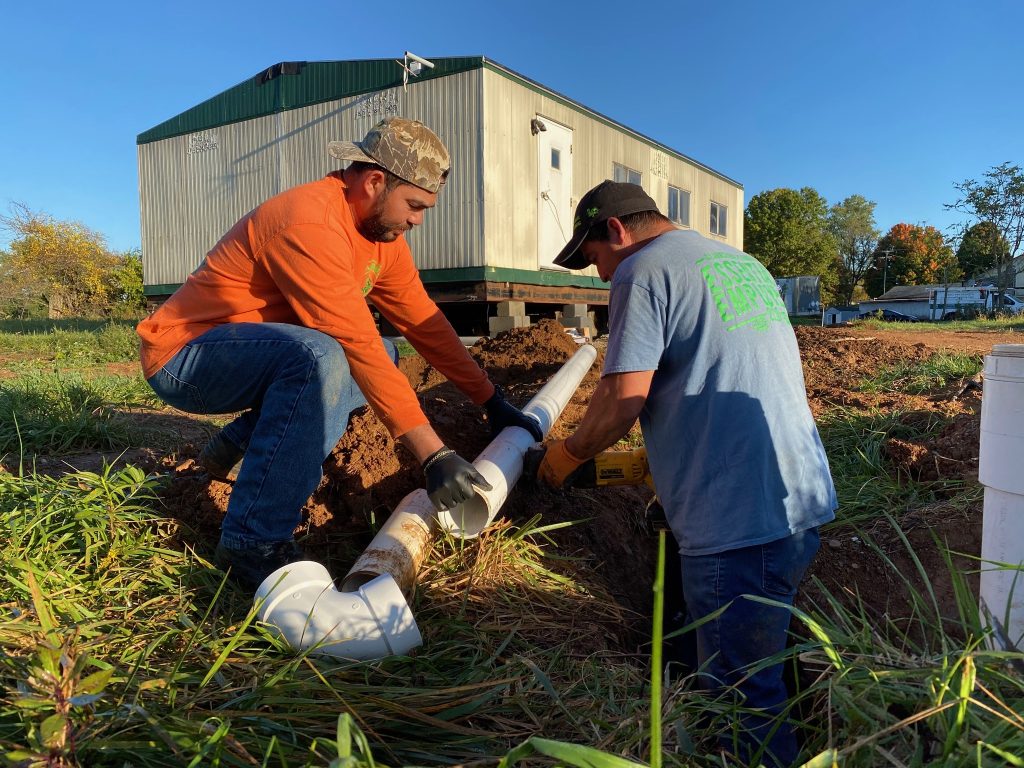
A crew excavates a trench the full length of the damaged sewer line, typically three to eight feet deep in Montgomery County depending on frost depth and lot grade. They remove the old pipe, install new PVC or HDPE, backfill the trench, compact the soil, and restore whatever surface existed above it. The excavation is done by machine, and depending on what sits over the line, that machine may need to break up a concrete driveway, lift a section of patio, or work around tree roots and landscaping.
The method is proven, code-compliant, and still the only viable approach when a pipe has fully collapsed, shifted significantly out of grade, or been crushed by soil movement to the point where no continuous path exists.
Trenchless vs. Traditional: A Direct Comparison
Property Disruption
Trenchless repairs require one or two small access pits, typically two to four feet square. Everything above the line, including the lawn, driveway, mature trees, irrigation systems, and hardscaping, stays intact. For homeowners in neighborhoods like Kentlands, Clarksburg’s Town Center, or older Bethesda subdivisions where mature landscaping and paved surfaces add real value, this difference is significant.
Traditional excavation removes whatever sits above the pipe for its full length. A 60-foot sewer run under a concrete driveway means breaking up and replacing that concrete in addition to the pipe work itself. Landscaping restoration, tree work, and hardscape repair are not included in most base plumbing estimates, and those costs add up quickly.
Repair Timeline
Most trenchless lining projects complete in a single day. Pipe bursting typically takes one to two days. Traditional excavation on a typical residential line takes three to five days for the pipe work alone, then additional time for surface restoration.
For homeowners without sewer service during a repair, shorter timelines matter practically. A one-day trenchless job versus a five-day excavation is not a minor scheduling difference.
Durability
Both methods, done correctly, produce results measured in decades. CIPP epoxy liners are rated for 50 years or more and resist root intrusion better than host pipe materials. Pipe bursting installs HDPE, which carries a similar service life. New PVC from a traditional replacement also lasts 50 or more years in typical soil conditions. Durability is not a meaningful differentiator between the methods. What matters more is whether the method was matched correctly to the pipe’s condition.
When Traditional Excavation Is the Right Choice
Trenchless technology does not work in every situation, and a plumber who tells you it always does is not giving you an honest assessment. Traditional excavation is the correct method when:
- The pipe has fully collapsed. A liner cannot adhere to rubble, and a bursting head cannot travel through a pipe with no continuous path. If the camera shows sections of the line that have caved in, excavation is the only option.
- The pipe grade is wrong. Sewer lines require a consistent downward slope to allow gravity to move waste toward the main. A pipe with a sag, a belly, or a reverse slope cannot be corrected by lining because the liner takes the shape of the host pipe. Fixing the grade requires digging to the problem area and re-setting the pipe on correct slope.
- The pipe has severely offset joints. Significant joint displacement, common in areas with clay-heavy soil that swells and shifts seasonally, can prevent a liner from passing through cleanly and a bursting head from pulling straight.
- The line runs in open, easily accessible ground. If a short section of pipe in an open yard at shallow depth fails, traditional replacement can be faster and genuinely less expensive than mobilizing trenchless equipment for a small job.
A camera inspection before any repair is non-negotiable precisely because it settles these questions before a method is committed to.
The WSSC Permit Requirement Every Montgomery County Homeowner Should Know
Sewer line repair and replacement in Montgomery County requires a permit from WSSC Water, not from the county itself. WSSC issues its own plumbing code, the 2024 WSSC Plumbing and Fuel Gas Code effective December 2025, and its own plumber licenses. A Maryland-licensed plumber who does not hold a WSSC license cannot legally perform sewer work on your home in Montgomery County.
This is not a formality. Unpermitted sewer work can complicate a future home sale, void a homeowner’s insurance claim related to the repair, and require costly correction if discovered during an inspection. Before hiring any contractor for sewer work in Clarksburg, Germantown, Gaithersburg, or any other WSSC-served community, confirm that they hold a current WSSC license and that they will pull the permit before work begins.
Clarksburg Plumbing holds a WSSC Journeyman License and handles all permitting for every sewer job in the service area. You do not need to navigate the permit process yourself.
Signs Your Montgomery County Sewer Line Needs Attention
Most sewer failures give weeks or months of warning before they become emergencies. Watch for these in your Clarksburg, Bethesda, Potomac, or Germantown home:
- Drains throughout the house run slow at the same time, not just one fixture.
- Gurgling sounds come from toilets or floor drains when other fixtures are in use.
- Sewage odors appear indoors or in the yard with no obvious source.
- Wet patches or unusually lush grass appear along the sewer line’s path in the yard.
- Your water bill climbs without a change in usage, suggesting a leak in the lateral.
Any one of these warrants a camera inspection. A camera scope identifies the problem, its location, and its severity in about an hour and gives you and your plumber the information needed to choose the right repair method.
What Clarksburg Plumbing Brings to Sewer Work in the DMV
Clarksburg Plumbing has served Clarksburg, MD, and the surrounding Montgomery County communities for over 15 years. The team performs residential sewer line repair and replacement using both trenchless and traditional methods, selecting the approach based on the camera inspection findings rather than a default preference for either.
Labor carries a one-year guarantee. Underground sewer services are warranted for three years. The company holds a WSSC Journeyman License, a WSSC Gas Journeyman License, earned WBENC certification in 2019, and is available 24 hours a day, seven days a week. Estimates are free, and pricing is provided upfront before work begins.
If you are also dealing with related issues, the same team handles drain cleaning and drain line services for recurring clogs and slow drains that precede or accompany sewer line problems.
Call 301-972-2223 or book a diagnosis online to schedule a camera inspection and get a clear answer about which repair method your property actually needs.
Frequently Asked Questions
How do I know if my sewer line needs repair or full replacement? A camera inspection settles the question. If the pipe has cracks, root infiltration, or minor joint offsets but still holds its shape and grade, repair is usually sufficient. If the pipe has collapsed sections, severe grade problems, or is made of Orangeburg, full replacement is typically the better investment.
Does trenchless sewer repair work on clay tile pipe? Yes. Clay tile, which is common in Montgomery County homes built before 1970, is one of the best candidates for CIPP lining. The clay provides a stable host structure for the epoxy liner, and lining eliminates the root infiltration that clay joints are prone to.
Does Clarksburg Plumbing serve cities outside Clarksburg, MD? Yes. Clarksburg Plumbing serves Gaithersburg, Germantown, Bethesda, Potomac, Olney, Poolesville, Boyds, Damascus, Rockville, and other Montgomery County communities. Call 301-972-2223 to confirm service to your address.
Do I need a permit for sewer line work in Montgomery County? Yes. WSSC Water issues plumbing permits for Montgomery County, not the county itself. The work must be performed by a WSSC-licensed plumber. Clarksburg Plumbing holds the required WSSC license and handles permitting for every job.