
Grease Traps · Clarksburg, MD
Grease Trap Installation & Replacement
Compliant kitchens, no surprises.
If grease gets into the sewer, it clogs lines and costs you fines and downtime. We install, replace, and repair grease traps and interceptors for restaurants and food-service businesses across Montgomery County, sized correctly and built to your local fats, oils, and grease rules, so your kitchen stays open and compliant.
Traps & interceptorsSized to local codeFOG compliance
Book OnlineCall Now
Sized & compliant
Built for your kitchen The basics
What a grease trap does, and why FOG matters
FOG, fats, oils, and grease, is the enemy of every commercial kitchen drain. A grease trap or interceptor captures it before it reaches the sewer, where it hardens, clogs lines, and causes backups for you and the whole system. Because of that, jurisdictions require food-service businesses to have a properly sized, maintained grease trap, and they enforce it. We handle the full picture: sizing the right unit for your kitchen, installing or replacing it to code, repairing what fails, and making sure it is sized and installed to pass inspection.
What we do
Grease trap services
Installation, replacement, and repair for restaurants and food-service businesses.
Grease Trap Installation
New grease traps and interceptors sized for your kitchen’s flow and installed to local code.
Grease Trap Replacement
Undersized, failing, or non-compliant units replaced with the right trap for your operation.
Grease Interceptors
Larger in-ground interceptors for high-volume kitchens and multi-tenant food halls.
Grease Trap Repair
Leaks, broken baffles, bad lids, and clogged inlets repaired to keep you running and compliant.
Grease Line Jetting
Hydro-jetting for grease-clogged kitchen drain lines, clearing buildup that slows your kitchen down.
FOG Compliance & Sizing
We size to your jurisdiction’s rules and help with the documentation, so you pass inspection.
How it works
Sized right, installed to code
The right trap, the right size, and the paperwork to prove it.
1
Assess your kitchen
We look at your fixtures, flow, and local FOG rules to determine what your kitchen requires.
2
Size the unit
We calculate the correct trap or interceptor size, undersized units fail and oversized ones waste money.
3
Install or replace
We install to code with proper venting and access, and pull permits where required.
4
Pass inspection
We pull permits where required and document the sizing and install, so it clears inspection.
Catch it early
Signs your grease trap needs service
A grease problem in a commercial kitchen escalates fast. These signs mean it is time to call.
Slow or backing-up kitchen drains
Grease buildup in the trap or line shows up first as sluggish, then backed-up kitchen drains.
Foul odors in the kitchen
A grease trap that is full or failing puts sewer and grease odors into your space.
Renovating or adding equipment
New cooking equipment or a remodel can change your required trap size and compliance.
Failed or flagged inspection
A citation or warning from the jurisdiction means your trap needs service, repair, or replacement.
Undersized for your volume
A trap too small for your kitchen overflows grease into the sewer, the exact thing it should prevent.
Opening or expanding a kitchen
New and expanding food-service spaces need the right trap sized and installed before you open.
Need a trap sized, replaced, or serviced?
Book OnlineCall (301) 972 2223
Know your options
Types of grease traps
We help you pick the right type and size for your kitchen, your volume, and your local rules.
Under-Sink Traps
Compact hydromechanical traps that fit under or beside kitchen sinks for lower-volume kitchens.
In-Ground Interceptors
Large-capacity interceptors buried outside, for high-volume restaurants and shared kitchens.
Automatic Units (GRU)
Automatic grease removal units that skim and collect grease continuously, with less manual cleaning.
FOG rules in Maryland
Why this matters in Maryland
Here is the catch: grease trap and FOG requirements are not the same everywhere. They vary by county and municipality across Maryland, sizing formulas, cleaning frequency, recordkeeping, and what counts as compliant all differ between jurisdictions and water authorities. As a local contractor, we know the rules where your business operates, so your trap is sized and serviced to the standard your inspector actually uses.
- Requirements differ by county and municipality
- We size to your jurisdiction's FOG formula
- We document sizing and installation for inspections
- Avoid fines, citations, and surprise shut-downs
Not sure of your rules?
We'll figure it out
Tell us where your kitchen is and what you cook, and we will tell you what your jurisdiction requires and what it costs.
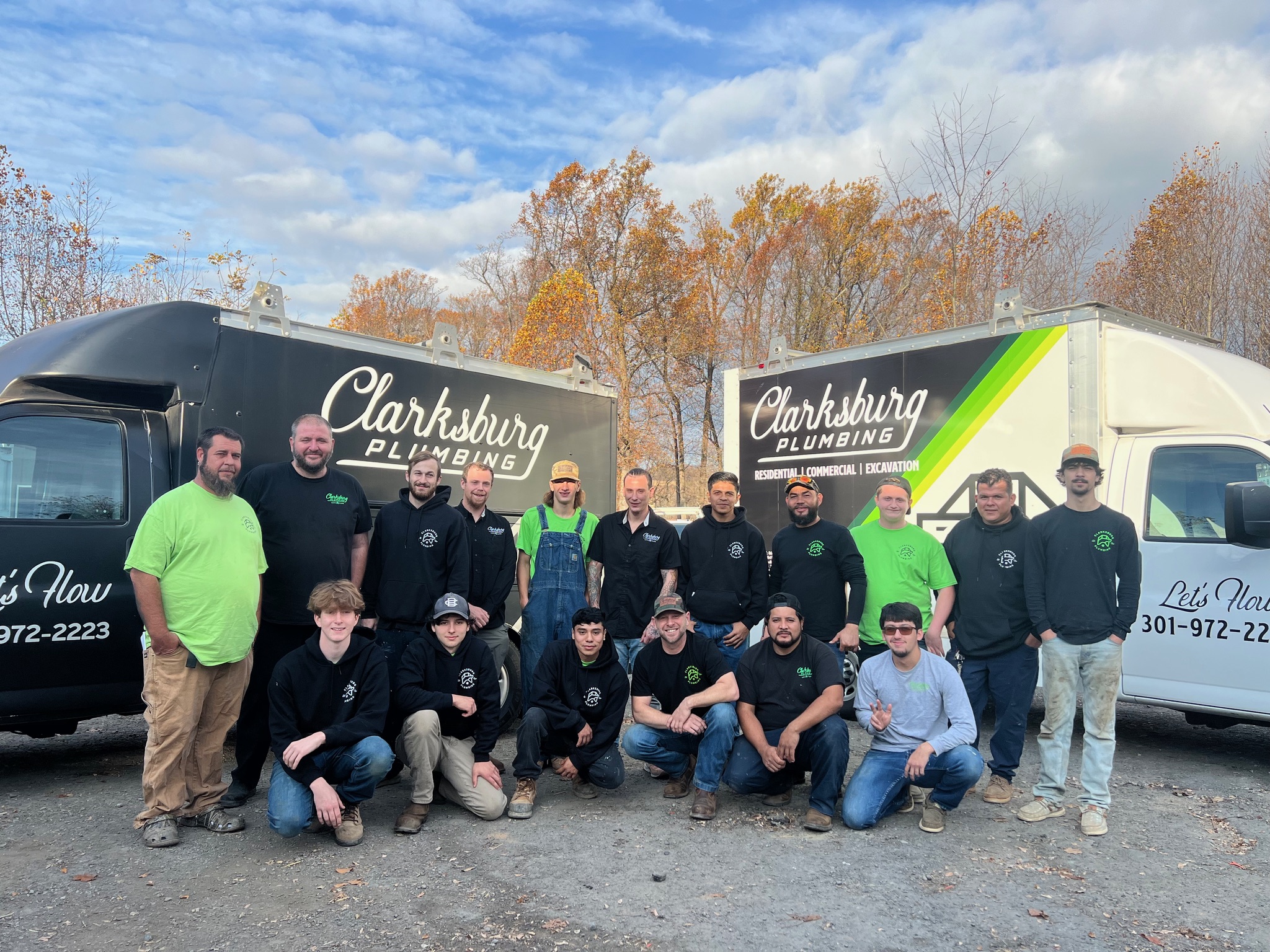
The commercial crew
A crew you are glad to let in
Grease trap work is messy and code-driven, and our own trained, background checked crew handles both, sizing and installing the right unit, keeping it serviced, and documenting it so your kitchen stays open and compliant.
From our neighbors
What your neighbors say
 Rating


Michele M.
October 8, 2026
I had an absolutely wonderful experience with Clarksburg Plumbing LLC, and especially with Seth. From the moment he arrived, he was professional, respectful, knowledgeable, and quite frankly, a breath of fresh air. I was extremely nervous about the situation because my leak was below the main water shutoff valves, and the water had to be turned off at the street. Seth immediately put me at ease and assured me that everything was going to be okay. Rather than just putting together a temporary solution, he wanted to make sure he ordered the exact parts needed to do the job properly. Seth told me he expected to have the correct part and be able to return on Wednesday to complete the repair. On Tuesday afternoon, the office called to let me know the part had arrived and confirmed that Seth would be back Wednesday morning between 8:00 and noon. Seth was at my door at 8:10 AM! I was genuinely impressed. He completed the repair carefully, explained everything he was doing, and was extremely conscientious about properly turning the water back on, opening the faucets in the house, and making sure everything was working exactly as it should. What impressed me most, though, was Seth himself. He has a wonderfully calm, professional demeanor that made a very stressful situation so much easier for me. I sincerely appreciate the care he took with my home and the respect he showed me throughout the entire process. Clarksburg Plumbing is very fortunate to have someone like Seth representing their company. I would absolutely recommend them and Seth!!


Natalie R.
September 29, 2026
I had a great experience with Tyler when he came out to replace our toilet flushing system. From start to finish, Tyler was incredibly courteous, professional, and knowledgeable. He walked me through what needed to be fixed, answered all my questions patiently, and completed the job efficiently. It’s rare to find such high-quality service and attention to detail. Everything is working perfectly now, and he left the work area completely clean. I highly recommend Tyler for any plumbing needs!


Robert B.
September 25, 2026
John and Maddy showed up on time and did a superb job. Very friendly and informative


Catherine J.
September 24, 2026
John and Maddie were fantastic. They fixed my original issue and then helped me out with a leaky shower and answered all my questions. I highly recommend both John and Maddie!

Pamela B.
September 21, 2026
Absolute best plumbers I have ever used. Needed them a few times recently and each time they were so professional, kind and resolved each problem the first time around. This last issue took them several hours to fix. They explained everything along the way and gave a very fair price for a lot of work. They also work very cleanly! I will never use another plumber! I wanted to add a new review but I could not so I am editing my previous one. I had to use Clarksburg Plumbing again today and like last time, they were exceptional. I was fortunate enough to have John and Madeleine as my service technicians. I will always request them going forward. They are kind, professional and knowledgeable! I am sure the company knows how fortunate they are to have them as part of their team!

John S.
September 18, 2026
We thank Clarksburg Plumbing again for superior, high quality and friendly service! ----- Clarksburg Plumbing visited us last week to repair an external spigot that had been leaking. The work involved creating a little inside access panel. Within and without, a nice, neat job by Charlie and his understudy apprentice, Chris. Problem solved and happy campers here! ----- UPDATE: Plumber John Brown presented himself on time and got right to work replacing my Mom's ancient leaky kitchen faucet with a new store-bought one that I provided. During the process, Mr. Brown detected and showed me two other problem areas contributing to the water leaks: a cracked drain pipe and then rusted threads on the sink trap. He efficiently and expertly repaired all three elements to our full satisfaction. Plus, John is a super nice guy, completely honest and classy enough to laugh at all my corny jokes! The next time you need any plumbing work in your home or business, I strongly endorse John Brown and anyone on the Clarksburg Plumbing team! UPDATE 2: John and his understudy Maddie visited, and quickly solved the problem of a pinhole leak in copper tubing leading from our hot water heater. He advised us on other plumbing needs, for which we have scheduled and will otherwise follow-up. Thank you Clarksburg Plumbing for your top quality people - John Brown in particular - and performance.

John H.
September 17, 2026
Their work was excellent. The problem solved a difficult situation with a water pipe leak and worked hard to implement it. Very grareful for the work of Franklin, Noah, Cotton, Markell, Tevon, Jason, Deybis

G M.
September 16, 2026
Tevon, Noah, Markell, and Morrow were sent by Clarksburg Plumbing LLC to repair an outside broken waterline They arrived at the appointed hour and completed the work in about 3 hours. I was very impressed with them and I would like to recommend all four of these very professional and friendly technicians. Clarksburg Plumbing is a fantastic organization; the office staff, Katie and Charlotte, who helped me are the best.

Tom F.
September 15, 2026
Our well lines began to leak after many years of service. Noah Zohrabi,YDeybis Gomez & Markel Watts came to the rescue! Excellent service from some very professional, courteous & knowledgeable folks!

Viannah E.
September 12, 2026
Thank you to Seth, who came on Wednesday and fixed one of our two toilets and fixed our primary bedroom shower. And thank you to Charlie, who came today and replaced our other toilet and replaced our garbage disposal. You are both lifesavers! Our weekend (and going forward) will be MUCH nicer now that we can use our bathrooms (and garbage disposal) again. Highly recommend Clarksburg Plumbing.

Ms. R.
September 11, 2026
Excellent service today from John Brown and Madeleine S. They were very kind and took time to explain the issue with my dishwasher. I really appreciate their professionalism and efficiency. I would definitely consider using this company again based on my service today!

Annabelle S.
September 11, 2026
GREAT service and expertise! John and Maddie just installed a water filtration system to our home. The process took one day to install and then they came back from the 48 hour install period to ensure everything was working well. John was familiar and knowledgeable about the water system we bought. Maddie and John kept our space clean, clearly explained how to ensure longevity for our system to last, and the difference it will make in our home. We appreciate their hard work and professionalism. This is our second time using Clarksburg plumbing. We would highly recommend their company to our family and friends.

Dia R.
September 11, 2026
We had a good experience with Clarksburg Plumbing: it was easy to schedule, they communicated clearly, arrived on time, and did a great job on completing the work.


Roxie H.
September 7, 2026
John did Excellent job with installing water refrigerator line for my refrigerator. My Condo was built 1983, and pipes were complicated, but not for John. He found it easy and finished the job in the timely manner. I am very happy customer. Thank you John!!

Rebecca W.
September 4, 2026
John Brown was knowledgeable, responsive and pragmatic. He saved us time by diagnosing then recommending best course of action. We are now waiting for the estimate for the project and will be going with Clarksburg Plumbing on our 1948 cap cod renovation. Highly recommend this company’s knowledge, professionalism and responsiveness.

vince R.
September 3, 2026
Franklin and his crew showed up promptly and communicated great with us to help limit disruption with the tenants at 4 of our building. Unfortunately for us a second water main leak occurred the day before. But luckily for us they were able to stay on site another 2 days and knock the second one out, even staying till 8pm to find the line and get it repaired. These will be the guys I request for our next time needs

Jonathan I.
September 3, 2026
Seth and Brady did a fantastic job replacing our water heater. They were professional, courteous, and detail oriented. They arrived on time and did careful, clean work all the way through. We have worked with Clarksburg Plumbing on smaller items before this and would be very happy to utilize their services in the future, as well.
Good questions
Grease trap FAQ
What restaurant owners and operators ask us most.
What is FOG and why does it require a grease trap?
FOG stands for fats, oils, and grease. In a commercial kitchen it washes down drains, then cools and hardens in the sewer, causing clogs and backups. A grease trap or interceptor captures FOG before it leaves your building, which is why jurisdictions require one for food-service businesses.
Do grease trap rules differ by location in Maryland?
Yes. Sizing, cleaning frequency, and recordkeeping requirements vary by county, municipality, and water authority across Maryland. We know the local rules where your business operates and size and service your trap to that standard.
Should I repair or replace my grease trap?
If the unit is the right size and structurally sound, repair, a baffle, lid, or inlet, is usually the fix. If it is undersized, badly corroded, or no longer compliant, replacement is the better call. We give you the honest recommendation.
What size grease trap do I need?
It depends on your fixtures, flow rate, and your jurisdiction’s formula. An undersized trap overflows grease into the sewer and fails inspection, while an oversized one wastes money. We calculate the correct size for your kitchen.
Do you clear grease-clogged kitchen drain lines?
Yes. We focus on grease trap installation, replacement, and repair, and we hydro-jet grease-clogged kitchen drain lines to keep them flowing. We do not provide routine grease trap pumping, but we can point you to a service for that.
Can you install a grease trap for a new restaurant build-out?
Absolutely. We size and install the right trap or interceptor as part of a kitchen build-out, coordinated with the rest of your plumbing and your opening schedule.
What areas do you serve?
We serve Clarksburg, Germantown, Gaithersburg, Rockville, Damascus, Potomac, North Bethesda, and the surrounding Montgomery and Frederick County area.
Stay compliant
Let's handle your grease trap.
Let's Flow.
Opening a kitchen, replacing an old trap, or behind on service? Book online or call a real person. We size it to your local rules, install or repair it, and keep you compliant. Here 24/7 for emergencies.
Book OnlineCall (301) 972 2223